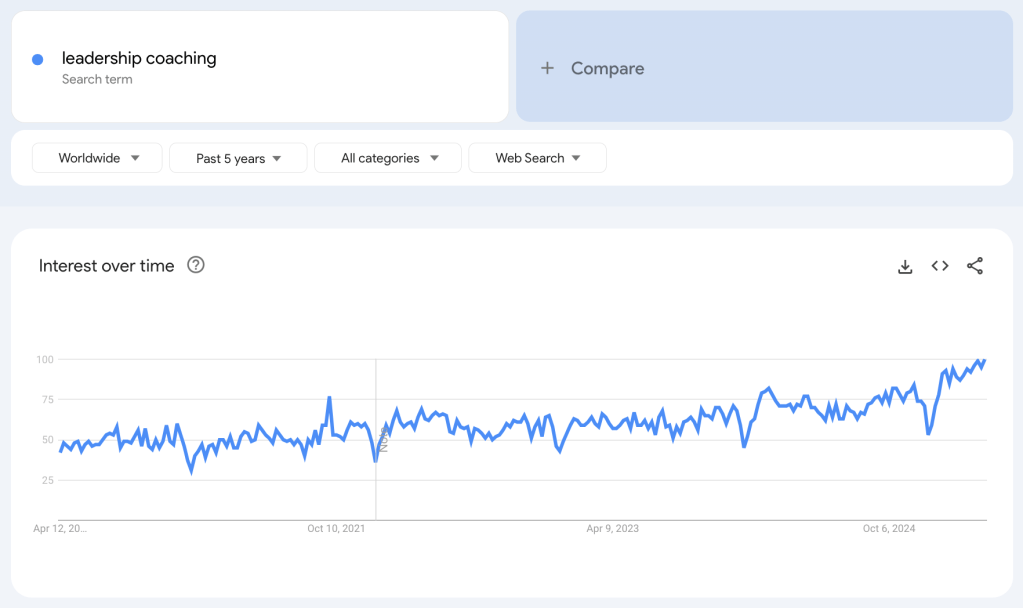
The search volume for “leadership coaching” has doubled in the last 5 years, and coaches need long-tail keywords to stand out (Google Trends)
Long-tail keywords are about to be come your new best friend. They are the best SEO keywords for coaches who want to optimise their website for search engines: a strategic ally for small and medium-sized coaching businesses to draw in traffic directly from Google’s results page, matching your website to the exact search queries of your next client.
They are your most helpful marketing tool to get discovered by your next client, particularly if you dread social media and are looking for solid alternatives. With the additional benefit of positioning you as the go-to expert in your field!
Why Long-Tail Keywords Perform Better
Just like any other business, coaches need a strong online presence if they want to attract and secure clients, as any prospect client will check out your website and social media before deciding to work with you.
What about all the people out there who are looking for a coach but don’t know one? They jump on Google and start searching. And I want to make you show up on the first page when they do, with the power of SEO marketing. This is effectively a way to access a new audience and get clients beyond word of mouth.
Broad keywords like “career coach” have a very high search volume, and, realistically, it’s going to be quite hard to rank for them if you’re just starting out with SEO, due to the high competition. On the flip side, long-tail keywords offer a strategic way to reach highly targeted audiences.
In this guide, we’ll explore what long-tail keywords are, how to find them, and how they can help grow your coaching business. And if you wonder how often a coach should blog, check out this article.
What Are Long-Tail Keywords?
Long-tail keywords are longer (usually 3+ words), more specific search phrases that users type into search engines.
Unlike short, highly competitive keywords (e.g., “business coach” or “life coaching”), long-tail keywords are more detailed, such as “career coach for changing job at 40” or “overcome emotional block in love”).
As a coach, you can target long-tail keywords and rank for them by writing curated blog articles, allowing you to be specific with each piece of content you create.
Why Are Long-Tail Keywords Important for Coaches?
It’s not that broad keywords don’t matter (and they do), but for coaches just starting to optimise their website it will be nearly impossible to rank for them, even if you write a thousand articles on just “coaching”. Realistically, do you even want to write shallow content? Or do you want to showcase your expertise and write deeper blogs?
Let’s look at what happens when you target long-tail keywords instead.
Improved SEO Strategy – Using long-tail keywords improves overall SEO by making your website more relevant to more specific searches.
Lower Competition – Long-tail keywords have less competition, making them easier to rank for and *actually* get traffic from.
Higher Conversion Rates – They attract highly targeted traffic from people who are looking exactly for the type of coaching you offer.
Thought Leadership – By blogging regularly about long-tail keywords, you have the opportunity to showcase your expertise and position yourself as an expert.

How to Find Long-Tail Keywords for the Coaching Industry
Now that we understand their importance, let’s explore how to discover long-tail keywords that will drive targeted traffic to your coaching website.
1. Use Google Autocomplete
Google’s search bar is a great tool for uncovering long-tail keywords. Simply start typing a relevant keyword (e.g., “business coaching for”) and note the suggested searches. These are very fair topics to write about, but as they come up as frequently searched on Google, it is expected that the competitiveness of these keywords is quite high.
2. Check Google’s “People Also Ask” & Related Searches
When you search for a topic, Google often displays a “People also ask” section with related queries. These can provide valuable keyword ideas that reflect real user search intent. However, just like the previous point, these topics are probably already well covered and therefore competitive too rank for.
3. Paid SEO Tools
Paid SEO tools like Ahrefs (my preferred option), SEMrush, and Ubersuggest help identify high-performing long-tail keywords by analysing search volume, competition, and related queries. These tools can be expensive, but they are the only way you can access keyword metrics to conduct proper keyword research, and compile your list of long-tail keywords in the coaching space.
4. Use Forums and Q&A Sites
Platforms like Quora and Reddit are a goldmine for discovering real-life questions potential clients are asking about coaching services. Browse these forums to get coaching topic ideas and write away!
6. Use Google Search Console
Google Search Console (which your website definitely is already linked to, correct?) provides valuable data on the search queries that are already driving traffic to your site. Look for long-tail keyword opportunities in your reports: which queries can you match more closely and write a full article about?
Examples of Long-Tail Keywords for the Coaching Industry
Here are some niche-specific long-tail keywords coaches can target:
Life Coaching
- “Habits for happiness course”
- “Overcome criticism in relationship”
- “Anger management routine for man”
Business Coaching
- “Scalable business idea for beginners”
- “Successful entrepreneur mindset with ADHD”
- “Best books for time management”
Career Coaching
- “Habits for happiness at work”
- “Change career to finance at 50”
- “Layoff preparation checklist”
Health & Wellness Coaching
- “Bad habits for health in women”
- “Stop overeating after breakup”
- “Best workout for forearms”
Implementing Long-Tail Keywords in Your SEO Strategy
Once you’ve identified the right long-tail keywords, it’s time to implement them effectively on your website and content strategy.
1. Optimise Your Website Pages
Incorporate long-tail keywords naturally into your website’s key areas:
- Page Titles
- Meta Descriptions
- Headings (H1, H2, H3)
- Image Alt Text
- URLs
2. Create High-Quality Blog Content
Write in-depth blog posts that target long-tail keywords. For example, a blog titled “7 ways to prepare before a round of layoff” can include multiple variations of long-tail keywords. Before you post it, cross-check your article against my 8 + BONUS Free SEO CHECKLIST for your next blog to rank on Google!
3. Develop a FAQ Section
Adding a FAQ section on your website targeting common long-tail searches can improve rankings and user experience, as these are exactly the questions your audience already has in mind. When you write them, put yourself in the shoes of a potential client to formulate them in the way that resonates the most.
4. Optimise for Voice Search
Many long-tail keywords resemble conversational queries used in voice search (e.g., “How to best prepare for a tech layoff?”). Optimising for voice search can help capture these users.
To optimise for voice search:
- Use Natural, Conversational Language: Voice searches tend to be phrased as full questions rather than short keywords. Structure your content to answer these questions naturally.
- Focus on Question-Based Keywords: Identify common questions your audience might ask through tools like AnswerThePublic and Google’s “People Also Ask.”
- Optimise for Local Searches: Many voice searches are location-based, such as “best business coach near me.” Ensure your Google My Business listing is updated.
- Improve Website Speed & Mobile Friendliness: Since most voice searches happen on mobile devices, a fast, mobile-optimised site increases your chances of ranking in voice search results.
5. Internal Linking
Link to related content on your website using long-tail keywords as anchor text. This helps improve SEO and keeps visitors engaged.

FAQ Section About The Best Coaching Keywords
1. What are long-tail keywords in SEO?
Long-tail keywords are longer (generally 3 words or more), more specific search phrases that attract targeted traffic with higher intent to convert.
2. Why are long-tail keywords important for coaches?
Because they are less competitive, they help coaches rank higher in search results, attract the right audience, and improve conversion rates.
3. How do I find long-tail keywords for my coaching business?
Use tools like Google autocomplete, SEO platforms, and forums to discover niche-specific search terms. Or get in touch with me!
4. How do I use long-tail keywords to attract coaching clients?
Incorporate them into website content, blogs, meta descriptions, and video content to increase visibility and traffic.
Conclusion: Long-tail Keywords Are The Best Keywords For Coaches
By using long-tail keywords strategically, you can improve your online visibility, attract more clients, and establish a strong digital presence for your coaching business.
Need help with keyword research? Get in touch today!

Ilaria Pellegrini is a SEO consultant and blog writer based in London, UK. With 8+ years of brand and digital marketing expertise, since 2023 she started working with wellness and coaching businesses to strengthen their online visibility and increase their chances of discoverability through SEO. https://www.maars.marketing
 maars marketing