
How Often Should I Blog?Best Blogging Frequency To Maximise Visibility
Blogging is one of the most effective SEO strategies for service providers to generate leads and establish authority in their niche, because it helps them increase their rankings on Google and other search engines.
However, many business owners struggle with the question: How often should I publish a blog? How many blog posts per month should I post? How many articles do I need to start ranking? The answer depends on your goals, competition, and available resources.
This article will explain why business websites need a blog, how strategic keyword research helps you rank, and how many blogs you need to see results. We’ll also cover different blogging frequency options to suit various budgets and objectives, including my signature package “The SEO Engine”, offering the creation of 4, 8, or 16 blogs per month.
If you’re not sold on the importance of blogging yet, check out this article: 10 Benefits of Blogging for Business Coaches.
Why Do Business Websites Have a Blog?
You may have noticed that many small businesses have a blog. Often (and it was the case for me years ago) it’s because business owners have that creative fire inside that makes them want to tell stories, explain their point of view on business, celebrate milestones and so on.
In reality, a blog is an essential part of a business website because it helps attract potential customers through organic search. Instead of relying solely on push techniques, like paid ads or social media, blogging allows businesses to pull in traffic in a sustainable, organic way. Let’s see how!
A Blog Allows You To Target Long-Tail Keywords
Unlike broad keywords that are already “taken” by big brands, long-tail keywords give smaller businesses a fighting chance to appear in search results. For example, instead of targeting “healthy lifestyle,” a health coach could target “healthy morning habits for corporate workers in London” to attract a more targeted audience through a well-crafted blog post.
Regularly writing high-quality blog content, and more specifically targeting one keyword per blog posts, signals to Google that you’re serious about your SEO game and makes you climb the ranks for keywords in your niche. An added benefit is that your readers will regularly get fresh content and view you as an expert in your field. Two birds with one stone!
How Many Blogs Do I Need to Rank on Google?
I’m sorry to say that there isn’t a fixed number of blogs that you need to rank on Google! It varies for everyone, and depends on a few different factors:
- Competition in your industry – The more competitive the industry, the higher the volume of content you need to stand out.
- Keyword strategy – Focusing on low-difficulty, high-volume keywords makes ranking easier. Check out this article on the best SEO keywords for coaching.
- Domain authority – Established sites with high authority backlinks need fewer blogs compared to new websites. Check out this article on backlink building strategies.
While there is no set number, SEO experts generally agree that a blog needs at least 50 to 100 high-quality blogs to see consistent traffic growth. However, publishing frequency is just as important as volume. Let’s see why!

How Often Should I Publish a Blog?
Industry research suggests that businesses should aim for a minimum of 4 blogs per month to maintain SEO momentum. However, for coaches who want to accelerate growth and generate leads sooner, a higher blogging frequency will help you rank faster.
Here’s a breakdown of different blogging frequencies:
4 Blogs per Month (Minimum Viable Option)
- Best for coaching businesses with existing lead-generation channels (paid and/or organic).
- Helps maintain SEO consistency and build topical authority over time.
- Suitable for coaches with limited budgets who want a steady content stream.
8 Blogs per Month (Balanced Growth)
- Ideal for coaching firms looking to increase search visibility without overwhelming their resources.
- Helps target a wider range of keywords and expand the website’s footprint.
- Great for coaching businesses that want to rank faster while maintaining a manageable workload.
16 Blogs per Month (Fastest Growth & Maximum Impact)
- Best for coaching companies that want to rank on Google quickly and attract new traffic at a high pace.
- Ideal for coaching businesses starting a blog from scratch and needing a strong content base.
- Helps dominate niche markets by covering more long-tail keywords.
Sources:
- HubSpot’s study on blogging frequency and lead generation (source)
- SEMrush’s content marketing research (source)
- Moz’s guide on content and SEO rankings (source)
How Keyword Research Shapes Your Blog Strategy
Effective blogging isn’t about publishing any articles. Like any other channel, it requires a strategic approach. This is where keyword research plays an unskippable role (and why you need an SEO expert if you’re aiming for success!).
Finding Keyword Gaps: Long-Tail Keywords
Keywords are, well… key words that you will use naturally when you write content. Let’s say, it’s the main topic that you target with each new post you write.
Big brands dominate broad keywords, making it hard for smaller or new businesses to compete because Google favours them thanks to their high reputation (aka, Domain Authority). Instead, a smart strategy involves:
- Identifying low-competition, high-volume keywords that are easier to rank for.
- Finding gaps in the keyword landscape where competitors aren’t focusing enough.
- Targeting long-tail keywords that attract more qualified leads.
For example, rather than writing a blog about, and therefore competing for “leadership coaching,” a boutique coaching consultancy could rank more easily for “best business coaching programmes for female entrepreneurs.”
See where I’m going? The more specific and targeted, the better.
Where do you find these infamous long-tail keywords though? Read more here: Best SEO Long-Tail Keywords For Coaching.
Building a Blog Strategy
Once you have a list of strategic keywords, they should serve as the skeleton of your blog strategy. Your keyword list will:
- Guide your content topics – Each blog should target a specific keyword to capture relevant traffic.
- Ensure SEO relevance – Writing for high-volume, low-competition keywords increases ranking chances.
- Drive lead generation – SEO-optimised blogs bring in organic traffic, that convert into customers through a well-placed Call To Action (CTA).
With this foundation, your blog becomes a strategic lead-generating tool, rather than just a collection of articles!
The SEO Content Engine: 4, 8, or 16 Blogs Per Month
To help businesses grow their online presence through blogging, maars marketing offers a signature package, The SEO Content Engine (find details of what is included in my Services page).
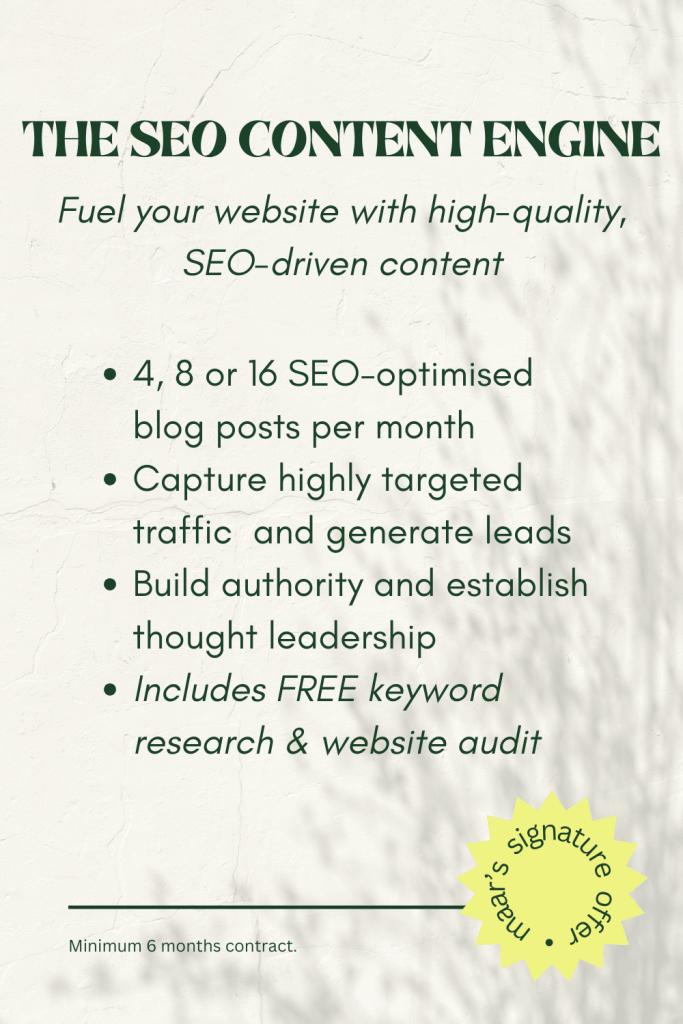
These packages provide flexibility to suit different budgets while delivering tangible results. Get in touch to know more!
Frequently Asked Questions (FAQs) About Blogging Frequency
1. Can I publish fewer than 4 blogs per month?
Technically, yes, but it’s not recommended. Publishing fewer than 4 blogs per month significantly slows down SEO growth and limits lead generation potential.
2. How long does it take for my blogs to rank on Google?
On average, blog posts take 3 to 6 months to rank on Google, depending on competition, keyword difficulty, and your website’s authority.
3. Should I focus on short or long-form content?
Longer blogs (1,200+ words) tend to rank better because they provide more in-depth value and the chance to target more variations of one individual keyword.
4. Do I need to do keyword research for every blog?
Yes. Each blog should be built around a keyword strategy to ensure it attracts the right audience and ranks effectively.
In conclusion, how often do I need to publish blog posts?
Blogging is a powerful lead generation tool, but success depends on frequency, strategy, and keyword research. By targeting long-tail keywords and publishing consistently at least 4 blogs per month, small businesses can effectively compete with larger brands.
My flexible blogging packages—4, 8, or 16 blogs per month—ensure that businesses of all sizes can leverage content marketing to achieve their goals.

Ilaria Pellegrini is a SEO consultant and blog writer based in London, UK. With 8+ years of brand and digital marketing expertise, since 2023 she started working with wellness and coaching businesses to strengthen their online visibility and increase their chances of discoverability through SEO. https://www.maars.marketing
 maars marketing