If you’re here, you are aware of the importance of blogging. And you know how blog posts allow you to be discovered by people who are already looking for what you offer. Which means higher conversion rates, which in turn make for a great alternative to social media to boost traffic to your website.
If you’re here, I’m guessing you’ve written a new piece of content, and you’re probably wondering: do I need to optimise it for SEO?
The short answer is no;
The long answer is – you guessed it – it depends! Keep on reading for the full breakdown on which type of content should definitely be optimised for search and which doesn’t!
There’s Only 2 Types of Content in This World
While all content forms benefit from being made searchable (even your latest TikTok video, yes), some types of content can be optimised more easily than others.
So let’s take a look at the 2 main types of content:
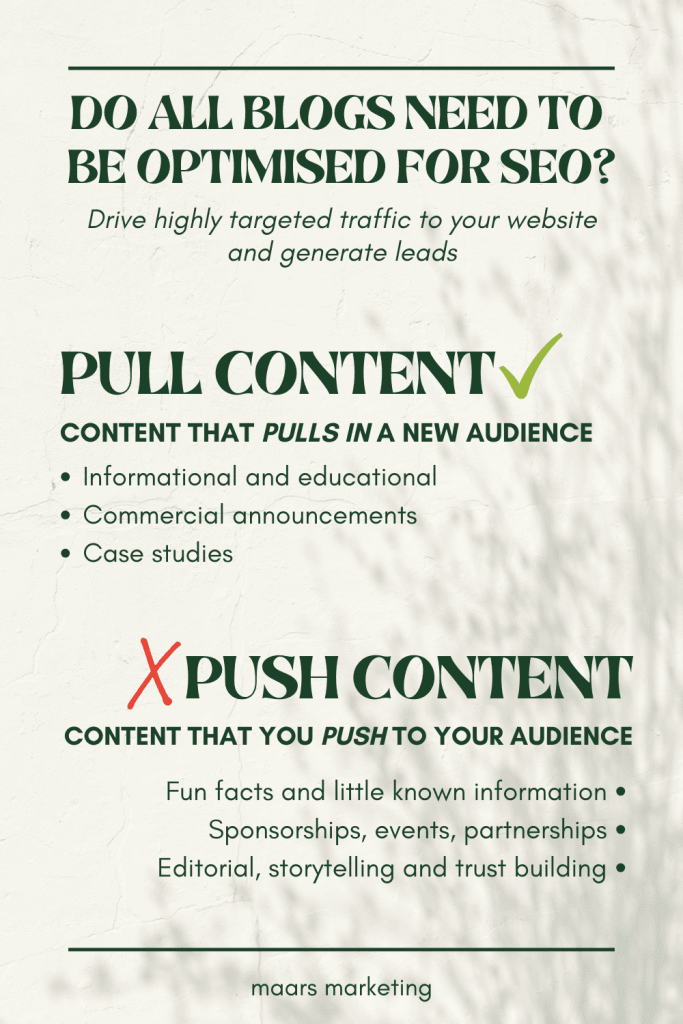
- Push content: this is a type of content that a brand pushes to their audience.
- Pull content: in this case, the content pulls in the audience.
Let’s look below at how this concept applies to long-form writing, blogs and articles. In particular, let’s look at which kind of blogs are more or less suitable for SEO optimisation.
Push Content Doesn’t Need Optimisation
Let me say it again: all blogs benefit from optimisation, so if you can optimise a push blog, that’s awesome! But this type of content is usually created to push information to your audience, because you want them to know something about you, and is generally hard to be optimised. Simply because of its nature, this type of content is probably not very searchable. Check out some examples below!
Examples:
- Fun Facts and little-known information: when a business wants to educate about a topic that’s not talked about enough, the topic is not searchable by definition. For example, I learnt that a diet can be the reason behind a lack of motivation thanks to this article I stumbled upon on social media, not because I googled it!
- Sponsorship and events announcements: when a brand sponsors an event, they want to let their audience know that they’ll be there. And gain marketing points (and backlinks) from associating their image to that of the event. They don’t expect many people to find out by googling “will brand XXX be at event YYY?”
- Storytelling, editorial and creative writing: when a business owner just wants to be creative and share a personal story or tell their journey: after all, this is how writing started!
- Trust building and thought leadership: if you sell an expensive service or product, you need to build your reputation with your audience, and create a relationship of trust with prospect clients and customers. Sometimes this type of content can be optimise, sometimes it can’t.
Pull Content Must Be Optimised
If you’re creating pull content (aka, content that has the potential to pull in an audience from the Google results page to your website) and you’re not optimising it, then you’re definitely missing out.
Examples:
- Commercial announcements: when a brand gets listed with a retailer and they title the blog “Surprise! HANX is Now Available At Sainsbury’s!“, they not only serve the purpose of answering a consumer availability question, but they attract traffic to their website and might make an online direct sale instead, capturing the entire revenue from the purchase.
- Informational and educational content: answering common questions like “Why is Vitamin D important?” will attract traffic to your website. If you then convince them that vitamin D is indeed important for their health, they will buy a box while they’re already on your website. Congrats, that’s a conversion!
- Case studies: essential to service providers and product sellers alike, you want to publish case studies that show your process and credentials, and infographics that show your results. Instead of titling them “Mary Smith Case Study”, choose a searchable title like “How We Helped a Struggling Supplements Brand Grow Again“
- Transactional-ish pages: if you’re new to working on SEO, your home page or service/product page are unlikely to rank high as of yet. Put your bets on a dedicated blog post describing your product or service in detail instead. Then, optimise it for your chosen keywords, like “Exploring Cold Exposure as an ADHD Management Tool” which is one of the first results for the query “ice bath adhd”
How To Make Your Content Pull In An Audience
So how do you make your content searchable? How do you turn a blog into a magnet that pulls in your target audience from Google? You do that with SEO.
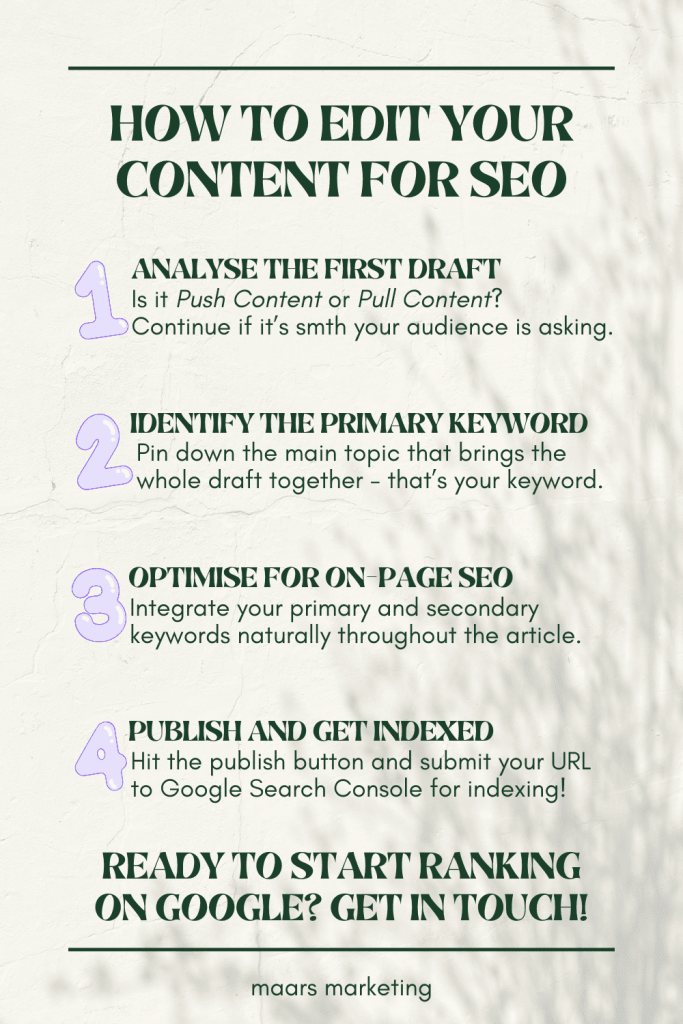
Step 1: Analyse The First Draft
Look at your draft and ask yourself: does this fall into the category of Push or Pull content?
If it’s Push Content (aka, something you want to tell your audience), optimising it might be complicated as your audience might not be actively searching for what you are saying. There is nothing wrong with that, and Push content has its own right to exist: it strengthens your brand with credibility and trust. Share your push content with the world via newsletter, social media and online magazines!
If it’s Pull Content (aka, something your audience is asking), you’re on the right track! Move on to Step 2.
Step 2: Identify The Primary Keyword
Look at your content again and try to find a topic that pulls it all together. Once you’ve identified a topic that pulls the whole article together, put yourself in the shoes of someone who might be interested in the topic: how would they search for it on Google?
For example, I recently edited an article for a leadership coaching company. The first draft they provided was a detailed description of one of the courses they offer. A very interesting and useful bundle of information. But it hadn’t been written in a way that could be found by someone looking for leadership coaching information online. So we identified one search term that worked as an umbrella to encompass and summarise what was written in the article. That’s the chosen primary keyword.
Top tip: it is best practice to pick one single primary keyword per blog post.
Step 3: Optimise For On-Page SEO
Now that you have a primary keyword, you have naturally integrate the primary keyword and its variations in your article so that Google understands the topic of your blog post and matches it with the right search queries.
You can find guidance in my free “SEO Checklist To Write A Blog Post That Ranks” and checking out this article on 10 SEO Mistakes in Wellness and How To Fix.
Step 4: Publish And Get Indexed
It’s time to hit the scary “Publish” button! Instead of clicking it and hiding under the carpet, you should copy the URL and immediately submit it to Google Search Console to prompt Google to crawl your new page and index it as soon as possible. This is how you speed up the process of getting shown for relevant queries!
How To Approach Writing Optimised Content Next Time
Ideally, the next time you start writing a piece of content with the intent that it is SEO optimised, you would want to identify what keyword you want to target before you start typing.
To identify the right keyword, one that has a decent level of traffic potential and an appropriate Keyword Difficulty for your domain, you need to do what’s called “keyword research”. Keyword research can be done with both free or paid tools, by yourself (have a look at this article on the Best SEO Keywords For Coaches) or with the help of an expert (wanna chat with me?). Get optimising!
So, does your next blog need optimisation?
If you’ve come to the conclusion that the article you’ve written will benefit from being made searchable, you can grab my free “SEO Checklist To Write A Blog Post That Ranks” and start optimising today!
If you’re looking for an SEO writer or editor, you can check out me services page or reach out to me here.

Ilaria Pellegrini is a SEO consultant and blog writer based in London, UK. With 8+ years of brand and digital marketing expertise, since 2023 she started working with wellness and coaching businesses to strengthen their online visibility and increase their chances of discoverability through SEO. https://www.maars.marketing
 maars marketing