Between March and April 2025 Google has rolled out its 2025 Core Update. In short, many websites in the wellness space have seen their SEO efforts being slashed as Google changed the ranking rules with zero notice. On the flip side, users are now seeing more relevant, accurate and trustworthy answers to their online questions.
How can you get back on track and make sure that your SEO strategy keeps supporting your marketing and sales? My top quick fix is that you improve your author crediting process. And you can do so in just a few small steps. Keep reading this article to see how.

What is a Core Update?
When talking about SEO, a Core Update is a significant, broad change to Google’s search algorithms and systems.
Google makes these changes multiple times a year, and one of the most recent and impactful ones was announced and rolled out in March 2025.
If you noticed a drop in impressions and clicks on Google Search Console after mid March, it’s very likely that your website was affected by the Core Update mentioned above.
What Content Works After The March 2025 Core Update?
Google has once again reinforced the importance of their E-E-A-T guidelines when it comes to evaluating content quality from a SEO standpoint.
Google ultimately wants something really simple: that their end users are happy with the results that come up for their searches.
E-E-A-T is an acronym that stands for Experience, Expertise, Authoritativeness and Trustworthiness, and it’s the essence of how Google evaluates how good your content is, and how likely it is to rank.
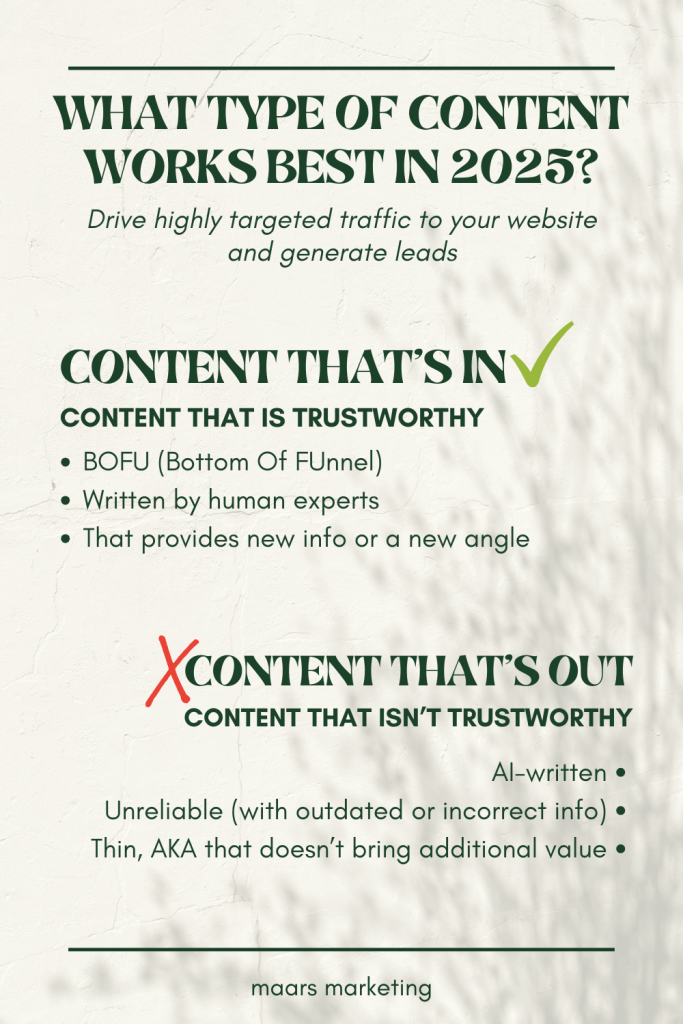
Content that isn’t trustworthy, hasn’t been written by someone with relevant experience in a given field, and doesn’t bring added value to what already exists online, is likely to lose positions and drop out of the top results spots. Especially in fields where inaccurate information can have serious consequences on a person’s wellbeing, life health and finance – known as YMYL fields.
Content that’s OUT:
- AI-written
- Unreliable (with outdated or incorrect information)
- Thin, AKA content that doesn’t bring much additional value compared to what already exists on the world wide net
On the other hand, Google doesn’t explicitly describe what type of content performs well, but according to the experts, it needs to be original, written by humans and generally provide fresh info, whether it’s in the form of presenting facts from a different perspective or adding entirely new statistics supported by research.
Content that’s IN:
- BOFU (stands for “Bottom Of FUnnel”)
- Written by human experts
- That provides new information or a new angle
How Do I Make Google Happy After March 2025?
While there are many articles offering tips on how to recover from the update, I will focus specifically on a relatively quick fix that anyone can implement in a few minutes. Crediting a blog’s author will improve your E-E-A-T score and make Google happy again!
E-E-A-T Best Practices: Author Credit and Bio
As I alway suggest, put yourself in the shoes of the end user. Let’s look at a realistic scenario: imagine a digital nomad wanting to explore Malaga, in Spain.
They want to learn basic information on the digital nomad scene in the city, so they might Google something like “malaga digital nomad hub”. This is known as a search query.
Google has hundreds of thousands of pieces of content on cold plunges and their benefits, and it has to find a way to prioritise these pieces in a way that makes sense for the reader. This is the process known as ranking for a search query.
While there are many factors that contribute to how well you can rank for search query, in this article we are looking specifically at the importance of the author credit as a sign of credibility and expertise.
In fact, after the March 2025 Core Update, Google wants to make sure users are reading trustworthy information, written by experts, therefore prioritising results that clearly states the name, role and relevant experience of the article author.
So the top results for a search query like “malaga digital nomad hub” are likely to be published on a well-known travel blog, a lifestyle magazine or a tourism board website. The article is likely to be written by someone who are themselves a digital nomad living in Malaga, which is likely detailed in their bio at the bottom of the page.
That is exactly how I was credited on my article on Malaga as a new digital nomad hub in Europe for NomadStays.com.
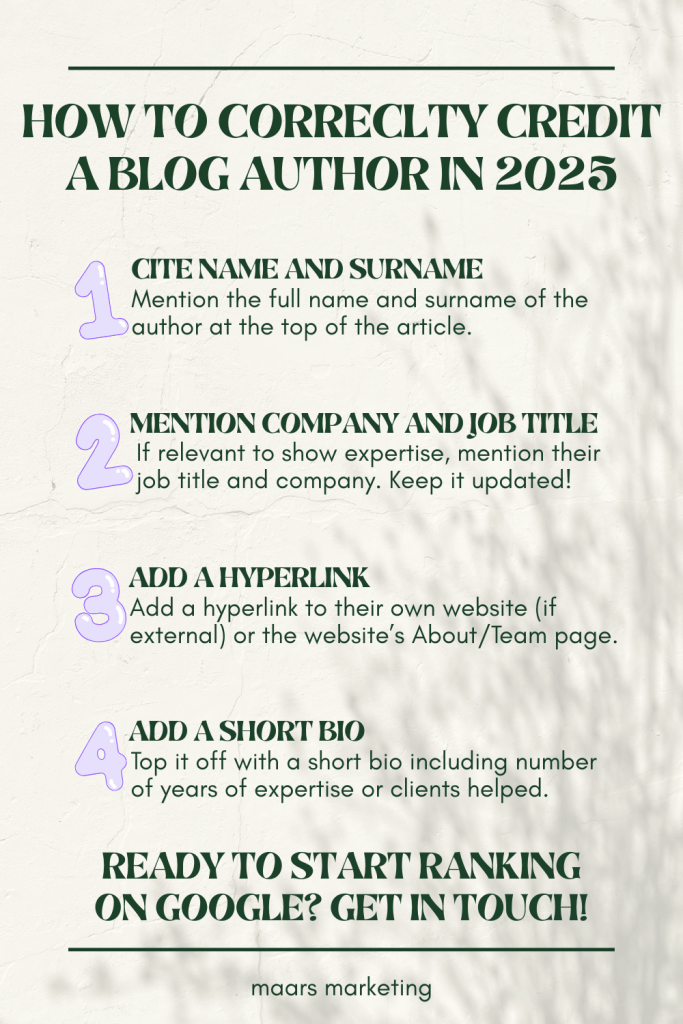
In your next article, you should:
- Clearly cite the author name and surname just below the article title;
- Mention their company name and job title, if relevant to the article field;
- Add a hyperlink to their website (if they have one) or their LinkedIn profile, or the About/Team page if it’s an internal member;
- Add a bio at the bottom of the article, if relevant, including numerical evidence (number of years in business, number of products sold/clients helped, …)
Author Crediting and Bio Real Examples
Some of the businesses killing it at crediting their authors, both when it’s their team writing them as well as when it’s a guest post, are:
And if you’re a freelancer, don’t forget to educate your clients on the importance of author crediting, as well as add a clause to your services agreement that details how you add author credits to the content you write for them.
For more resources to check out before you post your next SEO blog, check out these articles:
- Do All Blogs Need To Be SEO Optimised?
- Want Better SEO Rankings? Start with Digital PR and Backlinks
- How To Get Clients Beyond Word Of Mouth
Last but not least – you can grab my free SEO Checklist “Write a Blog Post That Ranks” to make sure you’re following the top SEO guidelines, beyond crediting your blog author.

Ilaria Pellegrini is a SEO consultant and blog writer based in London, UK. With 8+ years of brand and digital marketing expertise, since 2023 she started working with wellness and coaching businesses to strengthen their online visibility and increase their chances of discoverability through SEO. https://www.maars.marketing
 maars marketing